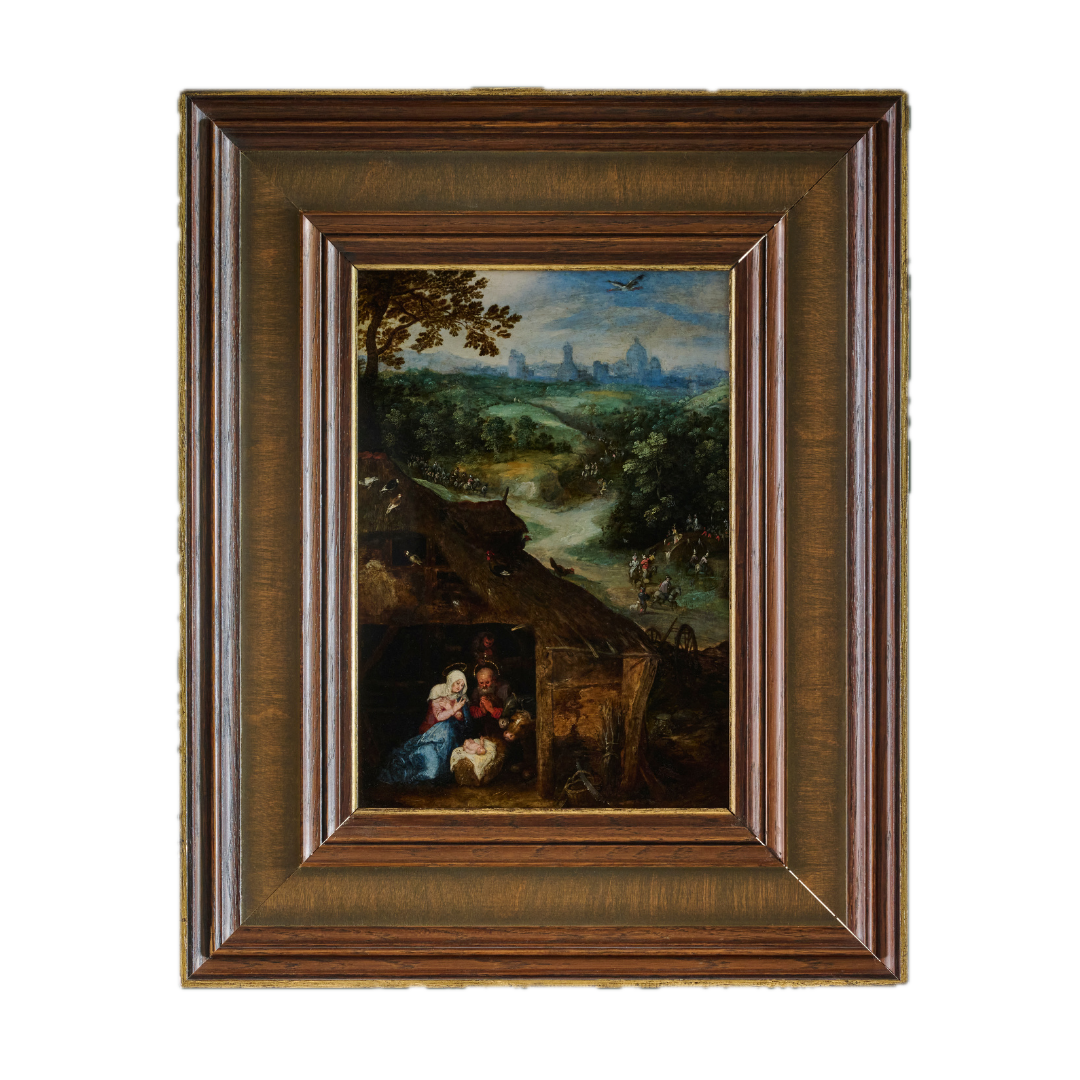
Every reader of the Gospels is familiar with the Nativity, the account of the Birth of Christ, and the Shepherds who came to see him having been told of his birth by Angels. And we all know the story of the Adoration of the Magi – the three wise men who came to worship Christ on seeing a star in the Eastern sky.
Together these three elements of the Gospels can be seen as successive stages in the introduction of Christ to the world. The paintings in our collection illustrate these stages.
When Christ is born, he is of course born from his Mother Mary. This is Christ’s first introduction to the world and underscores the primacy of the mother-child relationship to the Christian (and human) experience:
And she brought forth her firstborn son, and wrapped him in swaddling clothes, and laid him in a manger; because there was no room for them in the inn. (Luke 2:7)
In Christian Art, Joseph is traditionally depicted there in the manger with Mary and the Christ Child (as Luke later describes). Joseph is the next stage in Christ’s introduction to the world, and underscores the importance of the nuclear family to Christian culture.
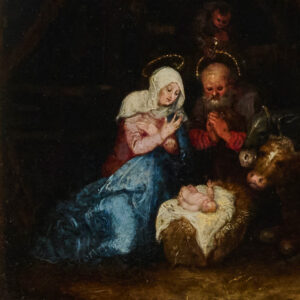
Any one of us who has set up a manger scene in our own home knows that these three figures are not alone in the typical scene.
They are accompanied by various animals: a cow, perhaps a donkey. Indeed we see both in our painting, adoring the Child alongside his parents.
This is the next stage of Christ’s introduction to the world: he is shown to the animal world. It is noteworthy that he is shown to animals before he is shown to anyone other than his parents. This underscores the importance of the natural world, and man’s communion with it, to Christianity.
Luke then describes how angels appeared before shepherds watching their flock by night to tell them of a birth of a Saviour. The shepherds went to find the child:
And it came to pass, as the angels were gone away from them into heaven, the shepherds said one to another, Let us now go even unto Bethlehem, and see this thing which is come to pass, which the Lord hath made known unto us. And they came with haste, and found Mary, and Joseph, and the babe lying in a manger. (Luke 2:15-16)
In the Shepherds, Christ is now introduced to the wider human world for the first time. The Shepherds are men who have mastered beasts, and they are the next step up from the natural world, but still very much part of it, as they have harnessed nature to feed themselves and their families.
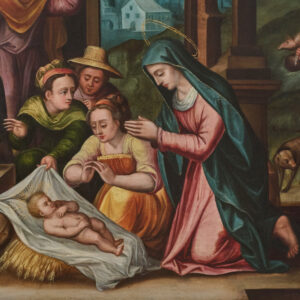
The Shepherds can also be seen as Christ’s introduction to the Jewish people. It is important that this happens before the next and final stage in Christ’s introduction to the world: the arrival of the three Magi.
…and, lo, the star, which they saw in the east, went before them, till it came and stood over where the young child was.When they saw the star, they rejoiced with exceeding great joy. And when they were come into the house, they saw the young child with Mary his mother, and fell down, and worshipped him: and when they had opened their treasures, they presented unto him gifts; gold, and frankincense and myrrh. (Matthew 2:9-11)
The Magi represent the remainder of the world outside Judaism. We can see them together representing the three parts of the world known at that time: Europe, Asia and Africa. In fact, one of the three magi – Balthazar by later tradition – came to be represented in Christian art with black skin. So it is in our painting.
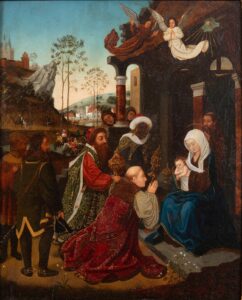
Although the Gospels only describe the Magi as “wise men,” by the third or fourth Century they were often described as Kings. Whatever their precise station, the visitors held high status in contemporary society; yet they fell to their knees and worshipped the Christ Child. This reinforces a core message of the Adoration of the Magi: the divine is superior to the earthly. Just as the Magi offered gifts to the child born in a stable, so we must honour the divine; and that divine may be, perhaps must be, found in the humblest of circumstances.
With brevity the Gospels have taken us through the narrative of Christ’s introduction to the world, and thus have shown how that world is ordered. Our paintings – in the finest tradition of Christian Art – have brought this narrative to life: we start with Christ and his mother, then the nuclear family, then the natural world, followed by the Jewish community and finally the wider human world represented by the Magi. As they are indeed Wise Men, they know to bow before the Divine, bringing us back to where we started: the Christ Child, both Man and God.
To view further imagery of our paintings click below: