Home » St. Hubert and the Iconography of the Hunt
St. Hubert and the Iconography of the Hunt
The legend
Hubert was born in the mid-7th century to a noble family in what is now Belgium. He was, by every account that survives, wholly devoted to the hunt, it consumed his time and, evidently, his priorities. On Good Friday, rather than attending mass, he was in the field pursuing a stag. The animal turned to face him, and between its antlers Hubert saw a vision of a crucifix. He renounced his titles, entered the priesthood, and was later made Bishop of Liège, where he became known for his ability to heal the sick. He died in 727 and was canonised in 743. He has been the patron saint of hunters ever since, a figure whose story does not condemn the hunt so much as locate something larger within it.
Reading the composition
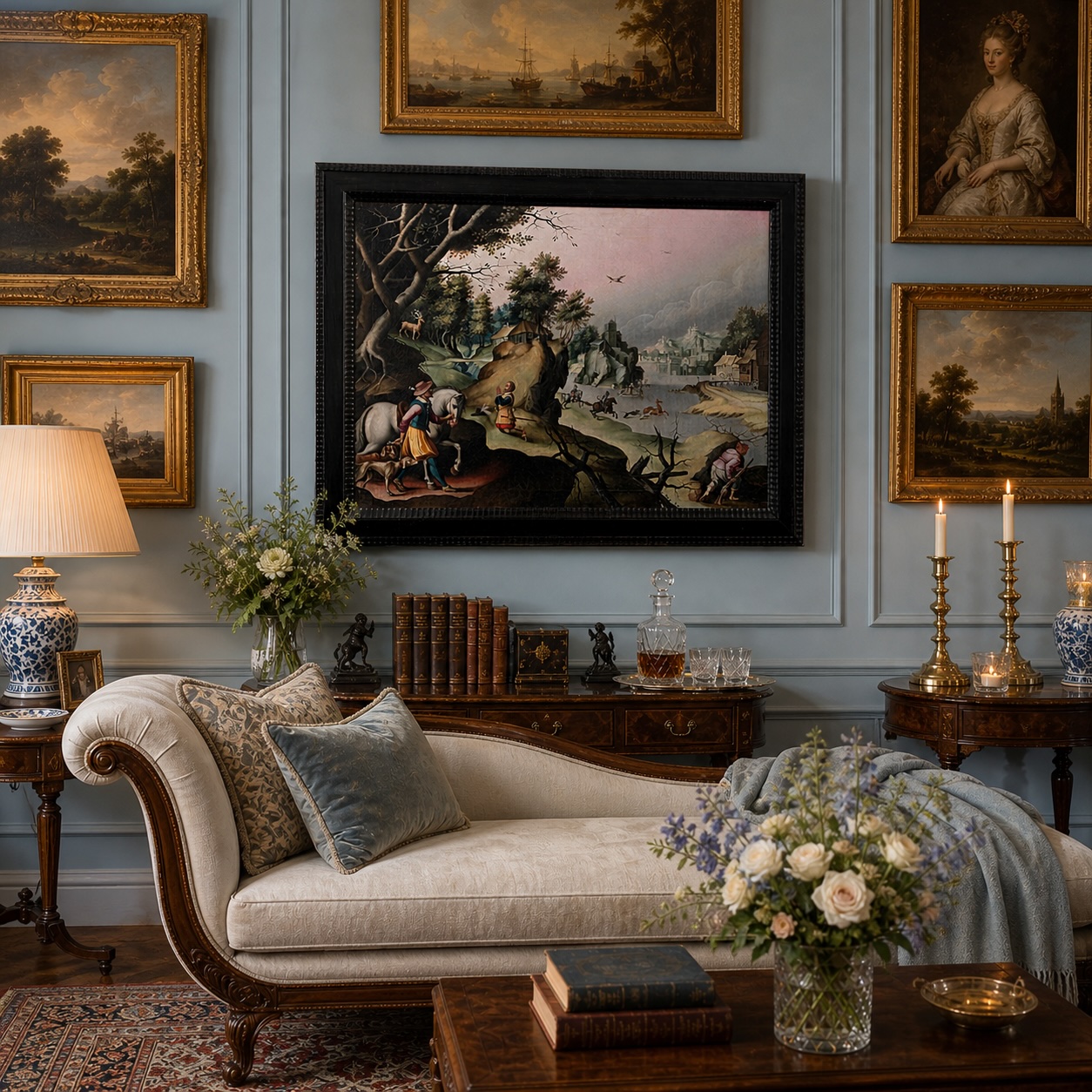
The painting sets the conversion within a fully realised hunting landscape, river, forest, craggy outcrops, hilltop towns in the distance, and populates it with hunting scenes that give the central subject its full context rather than diminishing it.
To the left, Hubert is shown entering the forest on horseback with his hounds, finely dressed, before the moment that will define him. In the lower right, a hunter crouches behind a rock, stalking prey outside the frame. At the centre, two mounted hunters drive a stag into a river as their hounds close in, a scene of considerable movement and tension. Behind them, a further hunting scene unfolds: a man fires a rifle into the water, the blast rendered directly on the surface, the fish beneath left to the viewer’s imagination.
The conversion itself is given the dominant position in the composition. Hubert kneels in prayer, his fine hat set aside, a halo already forming, the artist’s clearest signal that sainthood is imminent. Before him, on the hillside, the stag stands with one hoof raised, the crucifix visible between its antlers.
Attribution
The painting is unsigned, by an artist active in the late 16th or early 17th century. The Italianate character of the landscape suggests either an artist working in Italy or one closely engaged with Italian pictorial conventions. We attribute it to the Circle of Jan van der Straet, known also as Stradanus, a Flemish painter who spent the greater part of his career in Florence and produced a substantial body of hunting prints. Several passages in this composition show clear affinities with those prints, suggesting the artist was directly familiar with Stradanus’s work in this genre.
Context
Paintings of this subject were typically commissioned by patrons for whom hunting was a defining part of aristocratic life, and this example treats both dimensions of the story, the sport and the conversion, with equal seriousness. It sits within a well-established tradition of hunting iconography in Northern European painting, and remains, for collectors of sporting and equine art, one of the more historically resonant subjects available.
The Conversion of St. Hubert Circle of Jan van der Straet (1523–1605) Oil on canvas, painted surface 88.9 x 121.9 cm (35 x 48 inches); framed approx. 111.8 x 144.8 cm (44 x 57 inches)
Provenance: European private collection £24,500 excl. UK VAT
Share this article
Home » St. Hubert and the Iconography of the Hunt