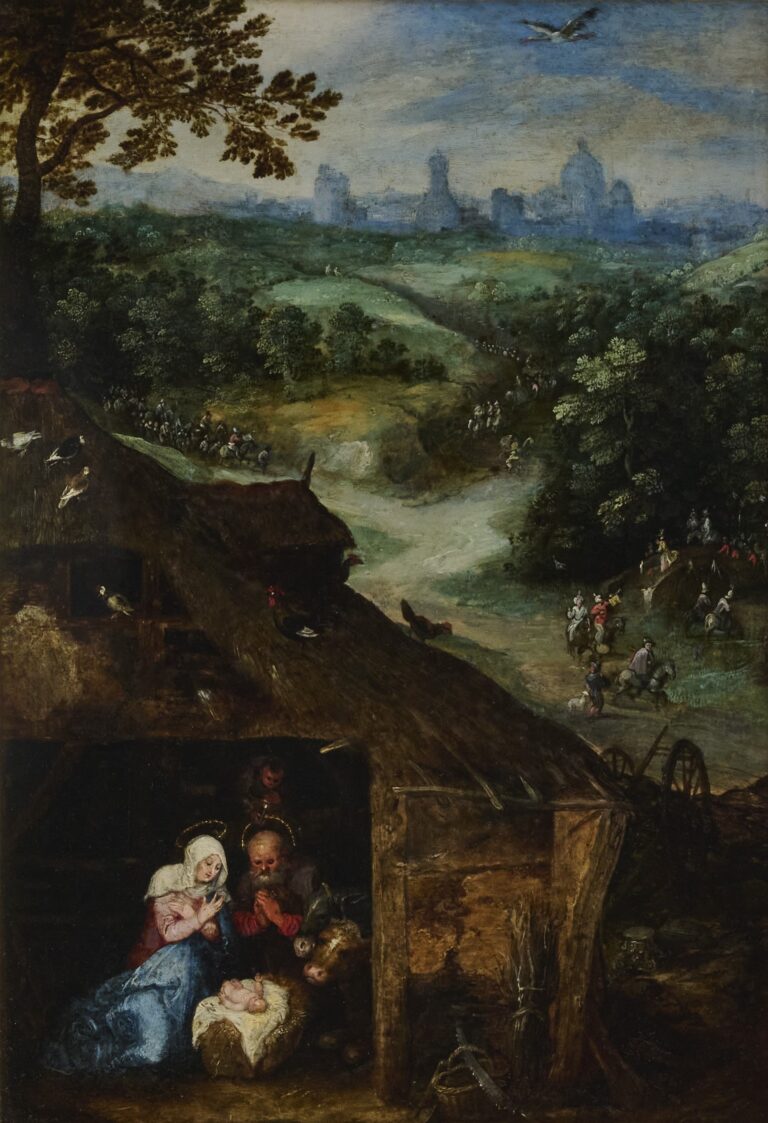
And when they were departed, behold, the angel of the Lord appeareth to Joseph in a dream, saying, Arise, and take the young child and his mother, and flee into Egypt, and be thou there until I bring thee word: for Herod will seek the young child to destroy him. When he arose, he took the young child and his mother by night, and departed into Egypt: And was there until the death of Herod: that it might be fulfilled which was spoken of the Lord by the prophet, saying, Out of Egypt have I called my son.
Matthew 2:13-15
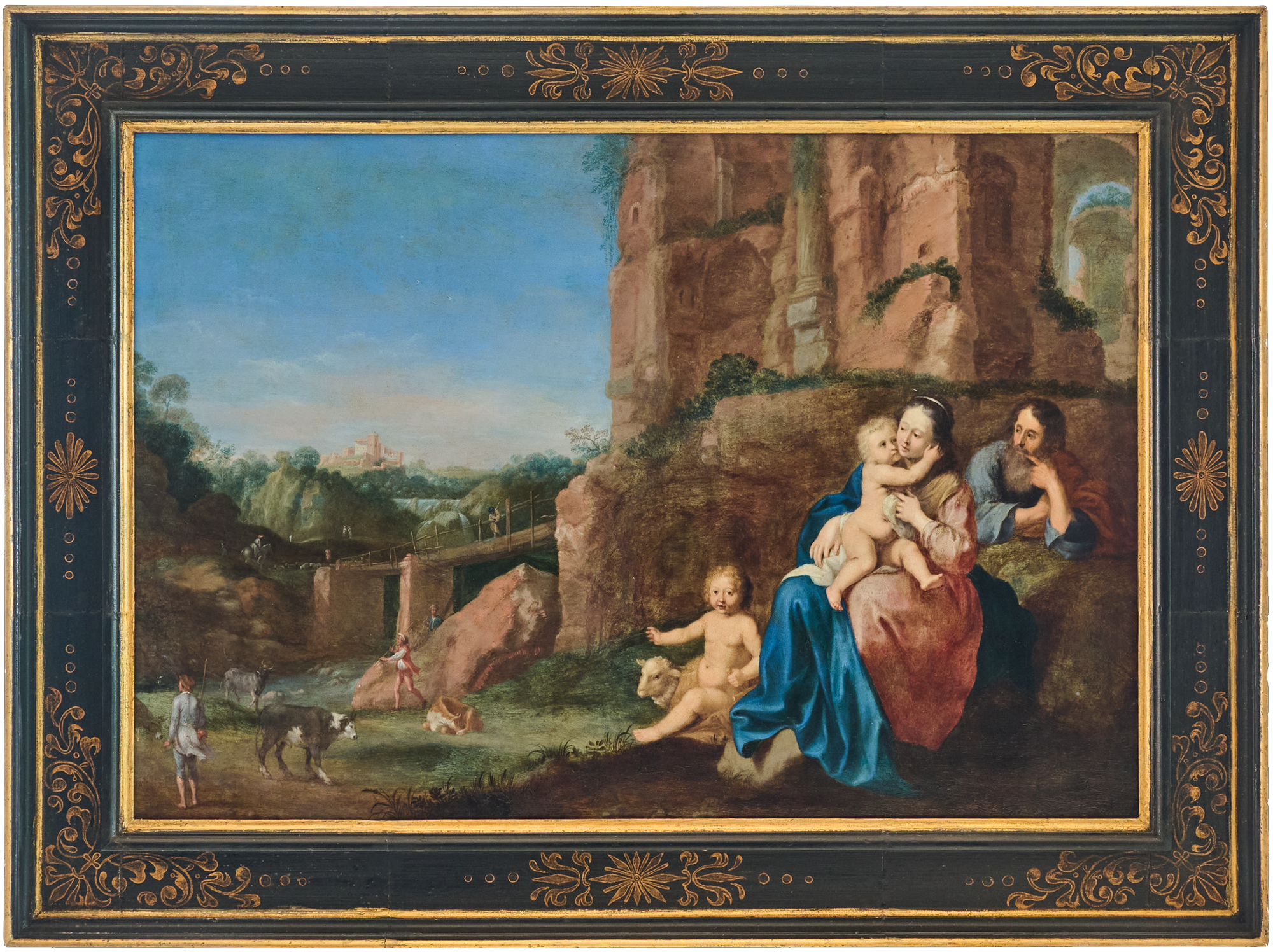
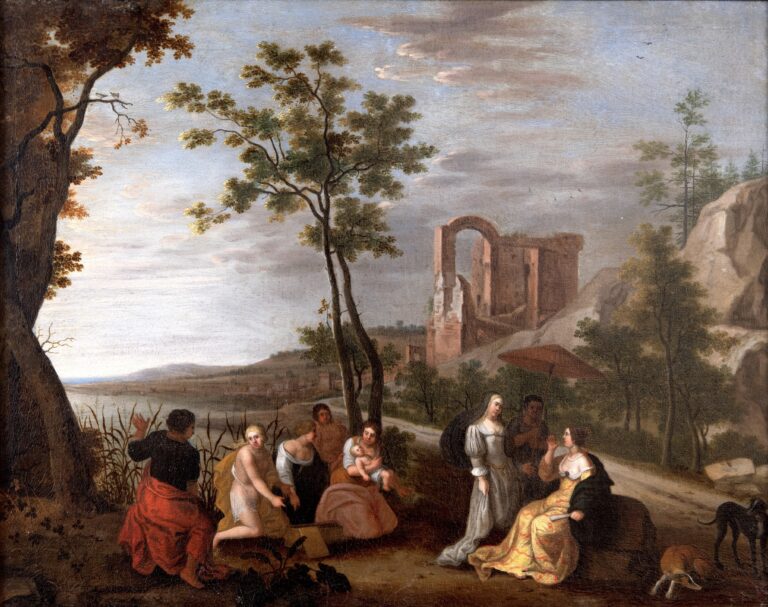
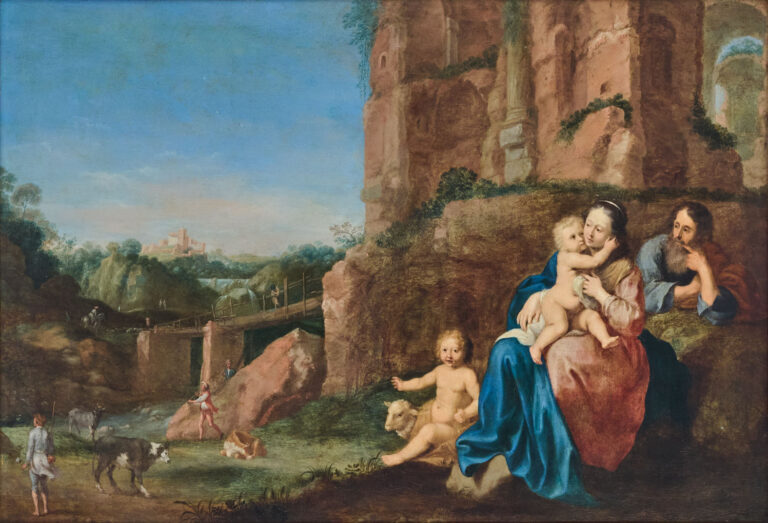
The subject depicted in our painting was a popular one during the Renaissance: the Holy Family resting during their Flight to Egypt, where they went to escape the murderous Herod.
Our painting is by an artist in the Circle of Bartholomeus Breenbergh (1598 – 1657), and is monogrammed “BB” on the stone below Mary’s cloak. According to the literature (Cornelis van Poelenburch (1594/5–1667): The paintings, no. 47) it is a copy of a work by Cornelis van Poelenburch belonging to the Hermitage and dates to 1650. The two painters were contemporaries and had similar styles, influenced by their time in Rome in the early 1600s.
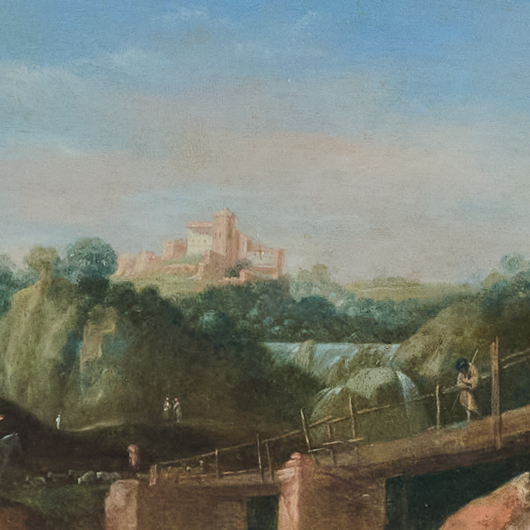
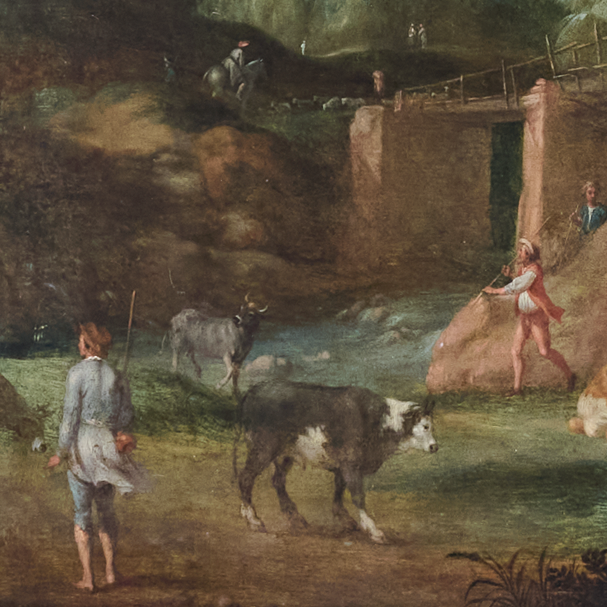
Breenbergh is known for his paintings of Italian ruins and landscapes, sometimes with an Old Testament scene mixed in. Our painting fits this pattern. The Holy Family rests against a backdrop of Italianate ruins. Nearby a shepherd tends his flock – an allusion to Christ as the Good Shepherd. In the background is a rickety bridge leading to a rocky outcrop and forested hills, topped with a fortified castle, all rendered with precision and beauty.
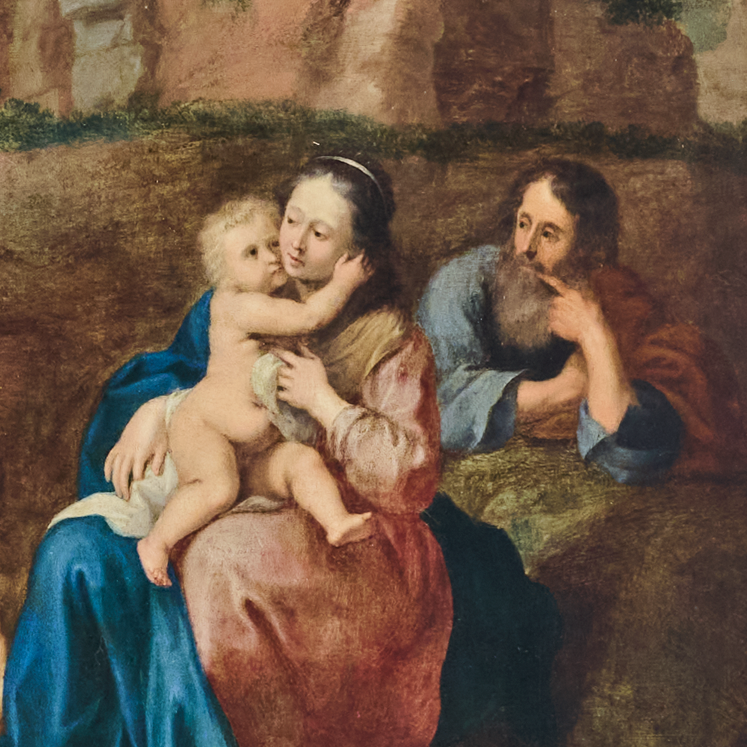
The Christ Child embraces Mary and presses his cheek to hers, as Joseph looks on. The Holy Family is shown with John the Baptist, a popular addition to the traditional Flight to Egypt iconography, the legend having grown, around Matthew’s minimal account, that the Holy Family met the infant John during their journey. John is holding a reed cross (partially obscured by Mary’s cloak) with a lamb lying at his feet, a reference to his saying about Christ: “Behold the Lamb of God, which taketh away the sin of the world”. The infant John is looking directly at us and gesturing to the lamb, as if remind us of the sacrifice of Christ’s life that is to come.
Provenance:
Sale, Vendu Notarishuis, Rotterdam, Kunst- en antiekveiling, 15 June 1972, lot 26 (as by P. Breenbergh, signed and dated 1650)
Barones Van Till, Netherlands, until 1973 (according in Jacobs 1973)
Alan Jacobs Gallery, London, from 1973 (reported in 1973 and 1976)
Sale, Christie’s, London, 16 May 1975, lot 88 (as Bartholomeus Breenbergh, signed and dated 1650)
Sale, Christie’s, London, Fine Old Master Pictures, 21 May 1976, lot 10 (as Bartholomeus Breenbergh, signed and dated 1650)
Galerie W. & R. Oberweger, Scrun, 1977
Sale, Christie’s, Amsterdam, Old Master Pictures and Drawings, 3 November 2004, lot 45 (as Circle of Bartholomeus Breenbergh, signed and dated 1650)
Sale, Kastern Auction, Hannover, 9 April 2005, lot 66, unsold (as by Bartholomeus Breenbergh, signed and dated 1650)
Frye & Sohn, Münster, until 2008
Private Collection, acquired form the above in 2008
Sale, Karl & Faber, Munich, Alte Meister, 29 April 2016 (as Circle of Bartholomeus Breenbergh, monogrammed ‘BB’)
Art Market Germany, 2024
Exhibited:
Alan Jacobs Gallery, Spring Exhibition, 1973 and 1976 (as by Bartholomeus Breenbergh)
Literature:
M. Roethlisberger, Bartholomeus Breenberg: the paintings, Berlin, 1981, n. 358 (as imitation of Bartholomeus Breenbergh, figures in the style of Cornelis Poelenburch)
N. Sluijter-Seijffert, Cornelis van Poelenburch (1594/5-1667): The paintings, Philadelphia, 2016, p. 306, n. 47 (copy 2, as a copy after Cornelis Poelenburgh)